Table of Contents
Fume Hood Challenge Participation Instructions
Full participation instructions for the Challenge. Read this document first.

Table of Contents
Introduction
Purpose and Intended Audience of This Document
This document describes the process of participation in I2SL's International Fume Hood Challenge, including the main steps to participate and links to further information on various Challenge topics. The information is intended to assist Challenge coordinators (the designated representatives from each participating organization) to plan and execute the Fume Hood Challenge activities at their organization. It can also be used by individuals considering Challenge participation to learn more about the steps involved.
Some Basic Information on the Challenge
The Fume Hood Challenge is a friendly global competition among organizations that own and operate laboratories containing fume hoods (also known as fume cupboards). The Challenge is designed to promote the safe and energy-efficient operation of fume hoods and to encourage collaboration among scientists, facilities staff, sustainability staff, and safety professionals within organizations.
The Challenge will be judged on a building-by-building basis. Participants in the 2027 Challenge should select a single building from their site to enter in the Challenge. Participation in the Challenge is free. Generally speaking, organizations that operate lab buildings containing fume hoods can participate in the Challenge. Full rules and eligibility requirements are listed here.
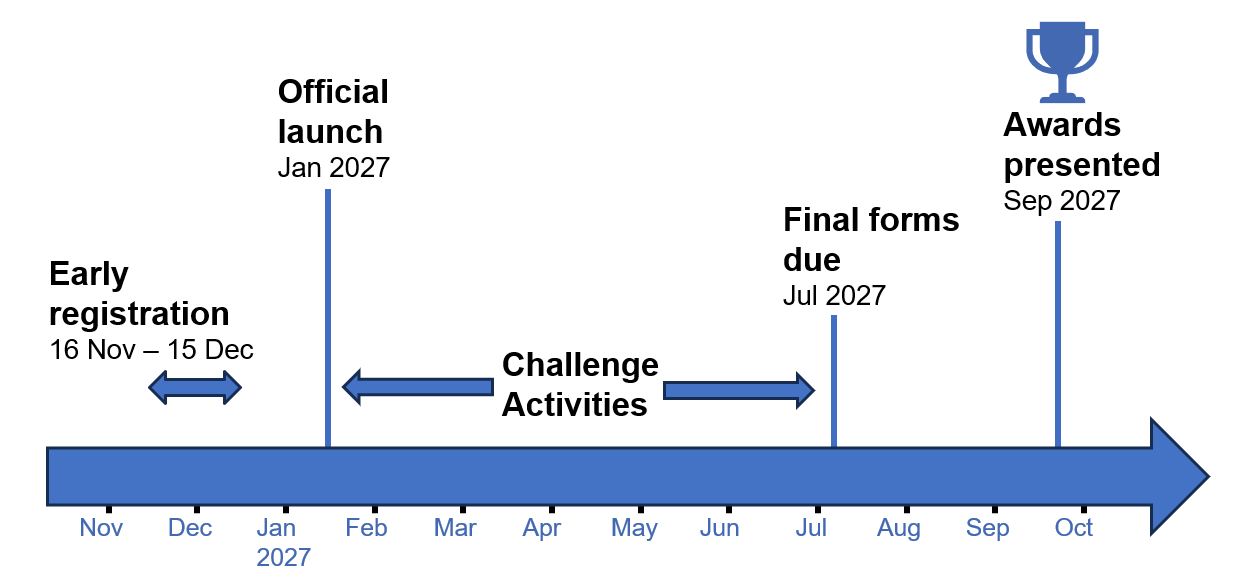
The Challenge is centered around a shut-the-sash competition to be held at each participating building at a time of the participant’s choosing between January and June of 2027. Points will be awarded for successful educational outreach and results. Crucially, the Challenge will also highlight the connection of fume hoods to the building’s ventilation systems, and Challenge activities will incorporate facilities and safety personnel. More general information about the Challenge is available here.
Being Part of the Challenge in Year 1
Data Submissions and Submission Timeline
Challenge data submissions will be gathered via Google Forms in Year 1, with some additional data submitted via I2SL’s Laboratory Benchmarking Tool. The Google forms contain a series of questions on the selected building and on the methods and results of the Challenge activities at the participating organization.
Phase of Challenge | Description of Activities | Forms to Complete | Deadlines | More Information and Resources |
Registration | Challenge Coordinator registers to participate. Building may be selected at this time (or can be done later). | December 15, 2026, for early registration February 28, 2027, for normal registration April 30, 2027, for late registration* | ||
Preparation | Finalize selection of building Gather building data Enter building in Lab Benchmarking Tool Run AIM Report Assemble team Create sash data plan Plan educational outreach | Form 1A: Building Selection (if not selected at registration) Form 2: Preparation Form 2A: HVAC response test (optional) | Form 1A due by February 28, 2027 Form 2 due by July 1, 2027 (bonus points if submitted by April 30, 2027) Form 2A due July 1, 2027 | Coming soon: Sash data instructions and appendix |
Results and Opportunities | Run local competition and award prizes Share technical information sheets with facilities personnel Report results of competition to I2SL Identify other opportunities in the building Offer Challenge feedback | Form 3: Results | Due July 1, 2027 (bonus if submitted by May 31, 2027) | Coming soon: |
*Late registration may be offered if space remains.
Judging and Awards
Points will be awarded based on the quality and completeness of preparation and data submissions, on the results achieved, and on the quality of other answers to the Challenge questions. Winners will be selected by a panel of judges selected from the I2SL Challenge Leadership Council, which oversees the Fume Hood Challenge. I2SL expects to award winners in multiple categories to reflect the different starting points and circumstances of the participating organizations.
Data validation requests will be issued in July (where needed), and winners will be notified in August. Awards will be presented at the awards luncheon at the I2SL Annual Conference on September 28, 2027. Winners will be invited to the I2SL Awards Luncheon and will also be invited to speak during a session about the awards on the same day. Challenge winners will also be awarded free AIM Report software subscriptions.
Filling out the Challenge Forms
A full list of the Challenge questions is available here. The points allocated to each question, the scoring method, optional and required response classifications, and some guidance text are provided with each question.
Most of the Challenge questions are multiple choice. Some questions request text answers, and these will be scored by the judging panel. For the text-response questions, please provide detailed answers with a focus on providing concise information on the requested topic, remembering to highlight any innovative methods that were used in your Challenge activities. Text response answers are limited to 3,000 characters (about 500 words).
Points are awarded for answering optional-response questions. These questions provide useful information for Challenge staff, for reporting of information, and for design of future years of the Challenge. Additional bonus points will be awarded for Challenge form submissions that are completed on time, and in some cases for early submission.

Guide to the Challenge Steps
Registration
The registration form should be completed by the Challenge Coordinator at each participating organization. To register, the Coordinator needs to provide contact information, indicate whether a Challenge building has already been selected, and agree to the Challenge rules. The form also asks for a short response giving the reason for participating in the 2027 Challenge.
Participant Selection
I2SL is accepting early registration applications from November 16, 2026. Applications will be reviewed and accepted on a rolling basis, with responses provided within two weeks of form submission. Accepted applicants will be issued with a participant code, which should be used on all future form submissions.
Application reviews will verify that the applicant and building appear to be real. Because space in the 2027 Challenge is limited, the review process will also attempt to ensure that participants from all major lab sectors and broad geographical regions are included, and will check that no more than one application has been submitted per site.
Terms and Conditions
The registration form includes agreement with the Challenge terms and conditions. This includes agreeing to the Challenge rules and agreeing to allow I2SL to identify award-winning organizations publicly. It also includes some other terms, which you can read here.

Preparation
Selecting a Challenge Building
For the 2027 Challenge, each participating organization should select one building to participate in the Fume Hood Challenge. For organizations with multiple large sites, one building per site may be submitted. Additional details on Challenge eligibility are provided in the Challenge Rules.
The participating building does not need to have been selected at the time of Challenge registration, but it must be selected and reported to I2SL by February 28, 2027, at the latest (use Form 1A if submitting building information separate from Challenge registration). Late building submissions will be accepted only if space allows.
Participants choosing among multiple candidate buildings are encouraged to select a building that could perform well in the Challenge or where participation could bring significant benefits to their organization.
Some features of strong candidate buildings might include:
- Collaborative facilities and EH&S teams at the building.
- A significant number of variable air volume (VAV) fume hoods, yielding good savings potential from shutting sashes.
- Interested and engaged building occupants (fume hood users).
- Good data availability, e.g., building areas, energy usage, and systems properties.
- Functional building ventilation systems with good data availability.
Technical tools that can be used to help select buildings include some tools that are already part of the Challenge toolkit. Use of these tools for the purpose of selecting a Challenge building is not mandatory for participation in the Challenge.
Assembling a Challenge Team
A successful Challenge entry should involve the collaboration of several stakeholder groups at a participating organization. The Challenge involves tasks relating to building data, HVAC systems, researcher engagement, and safety. Some groups to involve include:
- Challenge Coordinator
- Sustainability staff
- Energy management staff
- Researchers using the hoods
- Research leadership
- Facilities staff
- EH&S staff
- Communications staff
Gathering Building Data
The Challenge requires the Coordinator to gather and submit data on the participating building and its fume hoods. Gathering data on the hoods in the building that is participating in the Challenge is a recommended best practice for running a successful shut-the-sash competition.
We recommend collecting hood data in a spreadsheet and using this spreadsheet to track hoods throughout the competition. An example and further tips for data collection will be provided here (coming soon). Do not submit this spreadsheet to I2SL unless requested as part of the data verification process.
Some of the Form 2 (Preparation) questions ask about the typical sizes and types of fume hoods in the building. I2SL understands that buildings typically contain a variety of types of fume hoods, and asks that your answers reflect the predominant type in the building. Any additional information that is critical for an understanding of your building’s fume hoods should be provided in one of the narrative answers in the Challenge questionnaire.
Some of the data on the building’s hoods is also required to be submitted to the Lab Benchmarking Tool, which is covered in the next section of this document.
Using the LBT and AIM Report
Challenge Coordinators should arrange for the building to be entered in the I2SL Lab Benchmarking Tool (LBT) and to use the free demo version of the I2SL AIM Report energy calculation software (which is accessed via the LBT) to provide a shut-the-sash savings estimate. This savings estimate will be used as part of the Challenge’s internal calculations. Note that use of the I2SL software tools required for Challenge participation is free.
Detailed guides to using the LBT and AIM for Challenge data submissions are provided here (coming soon). The guides provide information about the highest priority data points for collection and the likely source of this information within an organization. In particular, staff from space planning, energy management, and facilities engineering departments are likely to have easy access to the types of data that are requested by LBT and AIM. Coordinators are encouraged to work with these groups at their organizations to collect required data and to forge longer-term connections for meaningful collaboration.
Creating an Outreach Plan
Participants should plan their educational outreach campaign during the preparation phase. Further details and resources on educational campaigns are provided in the “Running the Competition” section below.
Creating a Sash Data Plan
Before launching their local shut-the-sash competition, Challenge participants must develop a sash data plan. This plan must include a feasible method for collecting data on sash positions before and after (or during) the competition’s educational intervention.
All reasonable sash data collection methods are permitted (e.g., manual measurements, building automation system data, standalone sash monitor data). Data should be analyzed and translated into the requested summary metrics (see below) to allow comparison among Challenge entries. Submission of alternative metrics is permitted, but submissions using alternative metrics will not be eligible for maximum points in the sash data planning and results categories.
The requested sash position metrics are summarized below. For both the pre-intervention and post-intervention periods, this includes:
- Average sash opening percentage (as fraction of design hood opening).
- Average percentage of hoods with sash less than 20 percent open.
The full Challenge reference guide on sash data is located here (coming soon). This guide includes detailed definitions and some helpful appendices on sash data gathering and analysis, as well as a walkthrough of the data collection and analysis process for an example building.

Performing Simple HVAC Response Tests (optional)
Many different factors impact a building’s response to the movement of fume hood sashes. These include: the HVAC system control type; the type, number, and distribution of fume hoods in the building; lab room ventilation rates; and the functionality of the control systems. Many of these aspects can be included in calculations to predict the likely energy savings associated with shutting sashes, but a real-world check on the system’s response can be a very informative and useful tool, and can reveal operational challenges or features that were previously unknown.
A simple HVAC response test to determine the building’s response to moving fume hood sashes is included in the Challenge as an optional task. Completing this test and providing high-quality reporting on its results are eligible for Challenge points. This test is designed to be conducted with the collaboration of facilities and EH&S staff in the building.
The HVAC response test can be performed on a few candidate buildings to select the best candidate among them, or it can be used on the selected Challenge participant building to evaluate its response to sash movements and to identify opportunities for system improvements.
A detailed method of procedure is provided here (coming soon). The simple description of the test is as follows:
- Open all the sashes and record air handler and exhaust fan speeds.
- Close all the sashes and record air handler and exhaust fan speeds.
The magnitude of the fan speed response provides information about the potential savings associated with a shut-the-sash competition in the building, while any issues (e.g. stuck fume hoods, alarms, lack of response where response was expected) that arise during testing provide information about potential opportunities for improvement. Note that a poor result (limited response) in the HVAC response test does not disqualify a building from participating in the Challenge.

Shut-the-Sash Competition
Running the Competition
The local shut-the-sash competition should include an educational outreach effort, with measurements of sash position taken before and following the educational intervention to allow for quantification of behavioral improvements.
The educational intervention may take place at any time during the Challenge window (January through June 2027), provided sufficient data can be collected from both the pre- and post- intervention periods. Most educational interventions last two weeks to one month, and sash data from the pre- and post-intervention periods should cover at least two weeks each. The post-intervention period may be chosen to be during the educational intervention if desired, i.e. it does not need to take place after all educational activities have ended.
Each organization’s competition may look different, and should be designed according to the organization’s needs, local knowledge, and availability of data. Some tips for running a good shut-the-sash competition are listed in this article (coming soon). Case studies of competitions run by organizations in the past are available here (coming soon). Crucially, the educational component should include information for hood users on safe and appropriate use of fume hoods; some useful resources are listed here (coming soon).
The local competition may gauge progress and award local winners according to whatever participant subdivision (lab suite, individual hood user, etc.) or performance metric is desired, and labs from other buildings can be included if preferred. However, when submitting data to I2SL to compare against competitions at other organizations, sash data should be submitted for the entire Challenge building (and that building only) and should be in the format requested by I2SL whenever possible.
Submitting Sash Data
Sash data for the periods before and after the educational intervention should be submitted to I2SL via the Results form. The requested performance metrics should be submitted, along with any relevant narrative information (in one of the text answers). Raw data tables and lists of individual hoods’ sash positions should not be submitted to I2SL. If detailed data is needed for verification, it will be requested by I2SL during (or before) the judging period.
Sharing Best Practices
One of the Challenge activities involves sharing technical information sheets on hood maintenance and hibernation with facilities staff. These documents are provided here (coming soon) and are intended to start useful discussions on current organizational policies and any potential opportunities for improvement. It is not necessary for any of these guidelines to be adopted as lab policy in order to participate in the Challenge; participants can earn points for sharing these documents with the relevant personnel.

Identifying Opportunities
The Challenge asks all participants to identify further opportunities to reduce energy consumption in their facilities, and in particular the energy consumed by the HVAC systems serving the fume hoods and lab spaces, which are often responsible for 60 to 70 percent of total building energy use.
The Challenge task is to identify and report on potential opportunities to save energy. These projects do not need to be fully developed, funded, or implemented within the Challenge timeframe. It is expected and encouraged that the identification and initial development of potential opportunities will involve collaboration of the Challenge coordinator with at least some facilities and/or EH&S staff members at their organization.
Some examples of energy-saving opportunities include, but are not limited to:
● Hibernation or decommissioning of unused fume hoods
● Addition of variable air volume controls for fume hoods
● Low pressure drop filters for air handlers
● HVAC controls upgrades
● Unoccupied mode setback of lab temperature setpoints
● Rebalancing of lab airflows
There are many possible ways to identify these types of opportunities in lab facilities. Some of these include:
● Using the full version of I2SL’s AIM Report software to identify and quantify potential measures of interest.
● A traditional, onsite energy audit carried out by consultants or internal engineering staff.
● Review of building data, for example using a data analytics platform to identify faults and remediations.
● Exploring issues that arose during HVAC response testing earlier in the Challenge.
● Discussions with facilities or energy management staff about known potential opportunities to improve the energy performance of the building.
Providing Helpful Feedback
I2SL welcomes all feedback on the Fume Hood Challenge. Participants are welcome to contact I2SL (fhc@i2sl.org) at any time during the Challenge with questions, feedback, or issues that arise. In addition, the Challenge questionnaire contains a number of questions asking for feedback on the overall experience. Please answer these questions to allow the Challenge to improve in future years. One point is available for each feedback question answered.
The Challenge Forms